Alabama is being called to account.
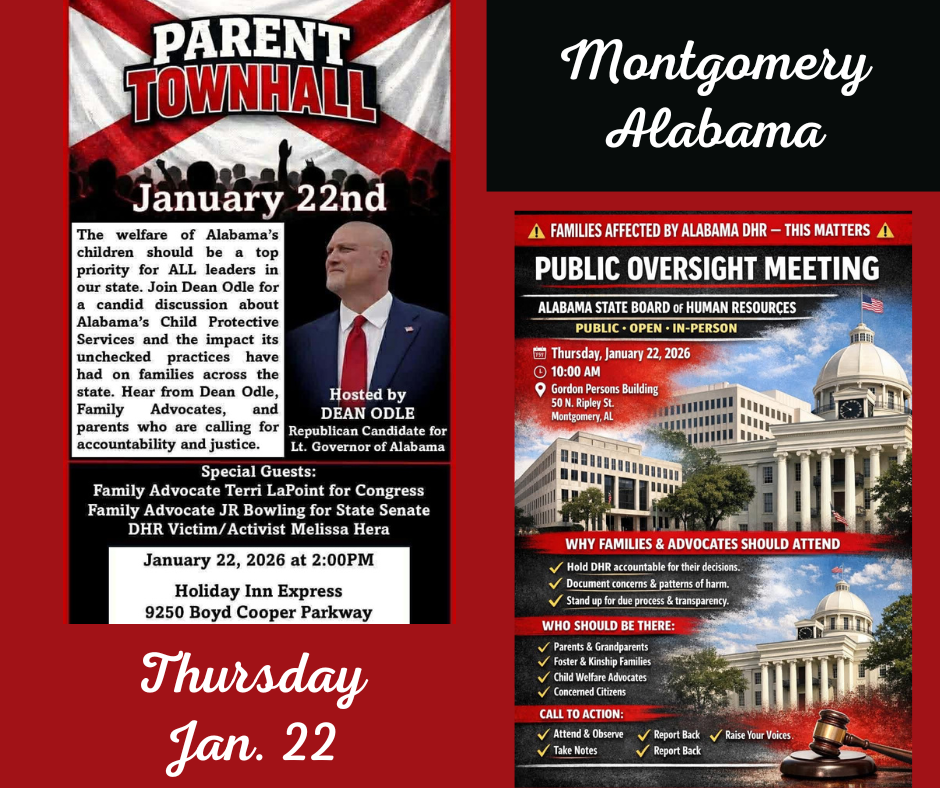
On January 22, families from across this state will arrive in Montgomery for two public events that expose a truth the system has long relied on silence to obscure. Oversight exists on paper. Accountability exists in statute. What has been missing is sustained public presence.
That morning, the Alabama State Board of Human Resources will hold a public oversight meeting in the Gordon Persons Building. These meetings are not symbolic. They are the formal mechanism through which the agency charged with child welfare is supposed to answer for its decisions. They exist so the public can observe how power is exercised, how policies are applied, and how harm is addressed when it occurs.
For families who have lived through investigations, removals, and prolonged separation, that room represents one of the few places where the system cannot simply move on. It is where decisions must be spoken aloud. It is where records are created. It is where silence becomes visible.
Later that same day, parents and advocates will gather again for a Parent Town Hall. This will not be a theoretical discussion about policy. It will be a record of experience. The people in that room are not outsiders commenting from a distance. They are the ones who were investigated, ordered, separated, and left navigating consequences that do not end when a case file is closed.
The proximity of these two events matters. One represents the official structure of oversight. The other represents the reality that structure was meant to protect. Together, they form a single message to the state of Alabama. Families are watching. Families are documenting. Families are no longer willing to be processed quietly and forgotten.
For years, parents have asked the same questions. Why are children removed without clear evidence of danger. Why are instructions inconsistent while enforcement remains unforgiving. Why are services promised but delayed or never delivered. Why are the same patterns raised repeatedly without correction. And how is it that state leadership can publicly celebrate an sixty- four percent increase in adoption rates while the public is given no comparable accounting of reunification outcomes. These questions have not faded. They have accumulated.
Public oversight only works when the public shows up. It only works when decisions are observed, recorded, and remembered. It only works when families are present not as case numbers, but as witnesses.
This is not about disruption. It is about visibility. It is about placing lived experience directly in the line of administrative process. It is about ensuring that what happens in closed offices does not remain abstract when it reaches families’ lives.
Attendance will not undo past harm. But absence guarantees future harm will continue unchecked.
January 22 is not a symbolic date. It is a line in the record. Alabama has been called. The system will either answer or it will be seen refusing to do so.